
Escaping the Touchscreen Trap
Why we keep buying bad products—and worse narratives

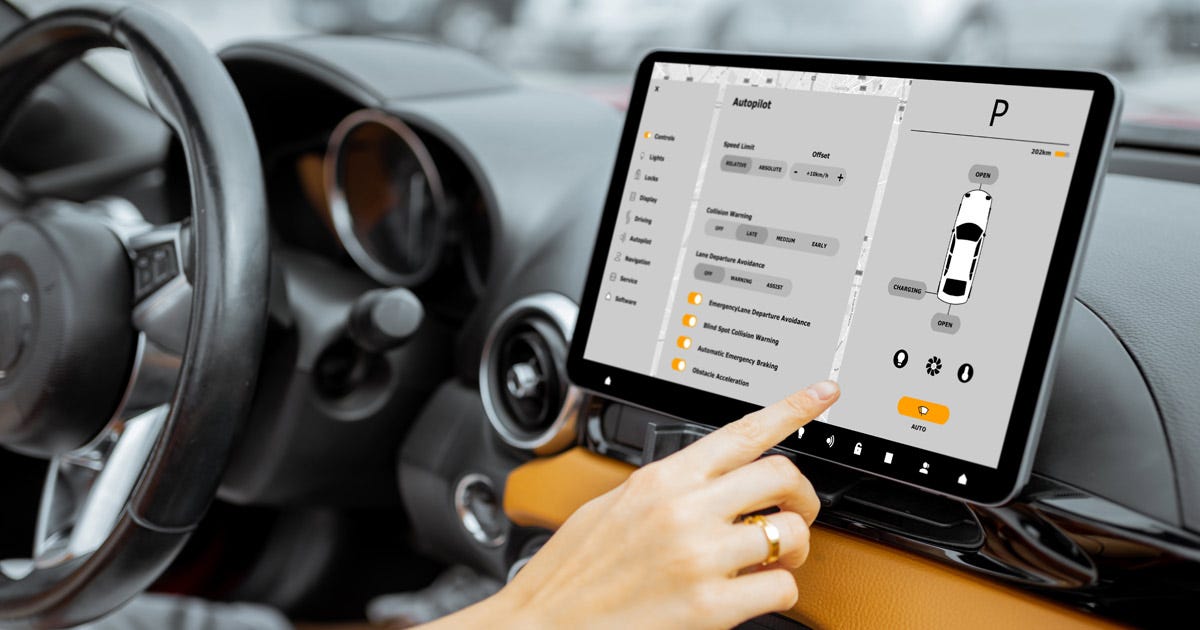
Why does it seem like the fancier everything gets, the worse it seems to work?
I found myself thinking about this a lot on a recent family trip (and ranting to my wife in true middle-aged curmudgeon fashion). It started before we pulled out of our driveway. No sooner do I turn on my 2022 Honda Odyssey than the minivan’s over-eager circuits latch onto my phone’s Bluetooth signal, and start auto-playing the audiobook I used to fall asleep last night at top volume. A few frantic pokes at the touchscreen succeed in silencing the interloper, but I know he will be back next time I turn on the car. Our Honda Odyssey had developed such a deep attachment to my Google Pixel over the prior few months that if I were on a work call in my home office, the call would suddenly get re-routed to our car’s speakers whenever my wife would turn on the vehicle in the driveway. More recently, they seem to have had a falling out; inexplicably, the devices are now so disconnected that I have to manually and tediously instruct the car that yes, it is allowed to talk to my Pixel every time I want to play music in the car. Once upon a time, this was simple: You just plugged one end of the 3.5 mm. AUX cable into your phone and the other end into your vehicle, tapped “Play,” and that was that.
The problems continued as we cruised down the interstate. The kids in the back said that they couldn’t hear the audiobook; then later they said they didn’t want to hear it (or maybe it was the other way around—you know the drill). Each request for sound modulation required using the van speakers’ Fade feature. I remember when I first discovered this feature on my parents’ minivan growing up, I thought it was the coolest thing ever. And so it was—with a simple twist of a little dial, you could crank up all the sound on the front speakers, or send it all to the third-class accommodations in the backseat. No longer. Today, this simple function requires no less than seven sequential tap and swipe gestures—almost none of them intuitive like that little dial—to access and modify the relevant setting on the vehicle’s sprawling touchscreen, plus another tap or two to bring the screen back to whatever it was showing before. And all of this must be done while guiding a 4,500-lb. metal enclosure through I-95 traffic at 70 mph. I confess I am not read up on vehicular accident attribution studies, but I would wager you that a non-trivial share of fatal accidents these days occur while occupants are trying to navigate some setting on their touchscreens. Indeed, European regulators have caught on, and are now beginning to penalize automobile safety scores for the use of touchscreens.
Almost everywhere you look, the old simple, intuitive, 100% functional analog dials have been replaced with opaque and confusing digital interfaces. Lord help anyone trying to find their way around an AirBNB kitchen these days. One morning of the trip, I found myself pounding frantically on every surface of our “smart stove” to try and find the precise sequence of touches at just the right pressure points that would activate a burner at medium heat to fry eggs, and positively pleading with the coffee pot to reveal the secrets of its hidden buttons, so that I could get enough caffeine to decipher the stovetop’s mysteries. On a previous family trip the year before, we’d pulled in to our AirBNB at 11 pm and woke up the next morning to find that the kitchen faucet would not dispense water. After countless fruitless endeavors, we finally contacted the hosts, only to receive a reply a few hours later: “It’s touch-activated”—(by a very specific and temperamental sequence and location of touches, it seemed)—“didn’t you read the online property manual?” It is as if we have all been transported, kicking and screaming, into a 2005 Sharper Image catalog.
Now, lest you think that I am self-indulgently using my Substack because my wife no longer wants to listen to my rants, I do have a substantive point to make here about the political economy of technology. I suspect it has a lot to do with Corey Doctorow’s much-discussed concept of “enshittification,” although I confess I haven’t yet read the full book-length treatment. He mostly focuses on monopolistic digital platforms like Facebook, Amazon, and TikTok, though, and enshittification seems to be a feature of the broader economy now, at least as this economy has embraced digitization. Almost wherever you look, it seems, once simple, perfectly functional consumer goods and household appliances have been replaced with digital or “smart” versions that are opaque, counterintuitive, and temperamental. This wouldn’t be worth complaining about, or writing about, if it was easy for curmudgeonly consumers to simply walk over to the next aisle and get the “if it ain’t broke don’t fix it” versions of those products. But of course, it’s not. Good luck shopping for a car built in the last several years that hasn’t replaced all its dials with an obnoxious screen-based interface.
Why “New” Isn’t Necessarily “Improved”
This state of affairs is inexplicable from the standpoint of the economics I was taught growing up: a happy fairy-tale land in which producers scoped out society for unmet needs and wants, for discontented consumers desperately demanding upgrades, and then designed new products to meet these needs, pocketing profits only if and when those consumers, overjoyed at the new opportunities to “maximize their utility,” voluntarily chose these superior products. Obviously this is not how real markets work—if it were, why would Apple spend so much money trying to convince consumers that it’s time to replace their iPhone 16 with an iPhone 17 Pro so they can enjoy its “smoother 120Hz ProMotion”?
In this particular case, the answer is obvious enough: it is the pattern of planned obsolescence that is baked in to modern consumer capitalism. Hannah Arendt shrewdly remarked on the phenomenon in her 1958 masterpiece The Human Condition: “The problem therefore is how to attune individual consumption to an unlimited accumulation of wealth. . . . The solution seems to be simple enough. It consists in treating all use objects as though they were consumer goods, so that a chair or a table is now consumed as rapidly as a dress and a dress used up almost as quickly as food” (124). Once a given industrial sector becomes optimized for mass production, it is not difficult for it to produce considerably more than consumers actually want or need. What then to do with the surplus production? How to keep people buying? Well, by offering constantly “new” and “improved” versions of your product. But what if your product is already about as “improved” as it could ever need to be? After all, while we often talk as if technological innovation was constantly improving everything, it’s actually much more complicated than that.
Within the physical world, at least, most of the technologies that anchor our society today achieved maturity decades ago. Consider aviation, which has enjoyed a 122-year history of innovation. This history doesn’t follow a straight linear ascent, much less an exponential upward curve, but rather something of an S-curve, one that mostly plateaued many decades ago. Sixty-one years and five days after the Wright Brothers first got their grotesque contraption airborne for 120 feet at Kitty Hawk, the Lockheed Corporation deployed the SR-71 Blackbird—still, in my opinion, the most beautiful and breathtaking product of American industry in the 20th century. Capable of climbing 200 feet per second to a ceiling of 85,000 feet, where it could cruise at 2,200 mph, eluding enemy radar through its incredible stealth design, the Blackbird took only 54 minutes on its final flight to go from Los Angeles to Washington Dulles, where it now lies in state as the centerpiece of the Udvar-Hazy Center, a temple to American technology. In the 61 years since the deployment of the Blackbird, we’ve tinkered and improved around the margins of aircraft design, but still cannot go faster or higher than the Blackbird. Something similar, of course, happened with the smartphone, albeit much more quickly. Within a decade, the technology was essentially mature, and future upgrades have just been tinkering around the margins, amplified by increasingly melodramatic advertising to try and convince increasingly reluctant consumers to upgrade.
Automobiles, too, have been a basically mature technology now for decades, at least until Tesla finally disrupted the market with breakthroughs in electric car design. Yes, cars have gotten marginally safer and more comfortable, but in terms of their primary functionality, our 2022 Honda Odyssey marks little improvement on a 1992 Honda Odyssey; indeed, if the complaints I began with are just, in some ways it marks a significant retrogression. None of this would be a big deal, however, if consumer choices multiplied in a mature market. Consider: you might think that if car manufacturers justified charging more for a “new and improved” touchscreen-enabled minivan, and many consumers hated it, that there would be a robust market for the older analog minivans, presumably at lower prices. But of course there’s not—I mean yes, there are always old used cars to buy, but cars do break down over time, so many people would like to be able to buy a brand-new car, only one with “retro” features. Similarly, you would think that the smartphone market would be inundated with suppliers offering dirt-cheap phone models based on perfectly-adequate 2016 technology, for consumers that don’t need a front-facing 48MP camera. But it isn’t. Why? Again, the market theory I was taught growing up said that free markets give consumers more and more choices of different options and price points.
Protocols and Shipping Containers: The Real Supply-Side Economics
So why don’t they? Don’t get me wrong; there are plenty of ways that they do. No one can enter a modern supermarket and not be awed by the range of options on display. On the other hand, frequently the illusion of choice masks an underlying monoculture: as when the massive cereal aisle seems to contain multiple brands which might all actually be produced at the same factory, and many different permutations of highly-processed wheat and high-fructose corn syrup which are in fact nutritionally all but identical. The modern supermarket, in fact, is a good example of how modern capitalism might give us a lot of choices about what to do within a narrowly-circumscribed system, but often gives us very little choice about whether to inhabit that system in the first place. And our current hyper-digitized economy is another. I might be able to choose between literally millions of different smartphone apps, but it is very difficult to choose not to carry a smartphone, or to buy a car that hasn’t been turned into a giant smartphone. We are of course witnessing something similar take place with AI—yes, you may have all sorts of choices about what to use AI for, but increasingly, you have no choice not to use AI, as it becomes simply baked in, without your request or consent, to every other app or platform that until now functioned perfectly fine without it.
The reality, of course, is that market dynamics are driven by the desires of producers every bit as much as by the yearnings of consumers. Indeed, when producers hold monopoly power—as in the US smartphone market or in the case of many digital platforms—they will largely be able to dictate which options are available, when, and for what price. This is one of Doctorow’s great complaints about our digital economy in Enshittification, one that we find echoed today on both right and left. However, as Jon Askonas has pointed out in “The New Control Society,” the reality is more complex: “As we approach the moment when all information everywhere from all time is available to everyone at once, what we find is not new artistic energy, not explosive diversity, but stifling sameness. Everything is converging — and it’s happening even as the power of the old monopolies and centralized tastemakers is broken up.” This, he argues, is because of the power of the protocol, which is to say essentially the shared algorithmic language that binds together our now incomprehensibly complex network of digital networks. Askonas’s dense and mammoth essay is essential reading for anyone wanting to understand the dynamics of modern society, and I will not attempt to summarize it further here. I will note only that something analogous to the “protocol” happens within any mass production ecosystem, where network constraints drive product design decisions.
Indeed, I had a lightbulb moment on this phenomenon just yesterday, having coffee with a DC attorney who used to run his own woodstove company until he realized that his whole job had been reduced to engineering flatter parts to fit into smaller boxes. For many companies, he said, shipping is their #1 expense, which means that design, increasingly, is driven not by consumer preference, but by the math of shipping containers. This explained something which I had just been ranting to my wife about—“why is it that so many hotel sinks these days are square and flat rather than round and funnel-shaped?” It’s extremely inconvenient if your goal is to get the detritus down the drain with the minimum of effort. Till now, I’d assumed that it was because of the inexplicable ebb and flows of consumer fashion, driven in some way by what the influencers on Instagram decided was hot right now. But what if those influencers on Instagram are in fact being incentivized to promote products designed simply to optimize shipping costs? The whole logic of the soulless modern minimalist aesthetic suddenly snapped into focus.
And the same thing goes, of course, for the automobile market. Suppliers want to cut their costs, and it turns out that running all of your car’s controls through one giant iPad interface is much cheaper than wiring a bunch of analog buttons and knobs. And thus they all converge on this solution to their ever-present problem of how to get consumers to pay more for less. But of course, it didn’t used to be that way; twenty years ago it was obviously not cheaper to put a big touchscreen in every car. However, Apple’s transformation of the digital economy in the late 2000s and 2010s had spillover effects into the analog economy, encouraging the digitization of everything by reshaping supply chains and manufacturing processes around touchscreen technology, creating massive economies of scale and driving down the costs of production. As car manufacturers crowded into the new space, older techniques of designing and manufacturing analog controls atrophied, causing the cost of controls to climb, and increasing the disincentive for any rebel “retro” car company to keep building the older interfaces. Costs of production, in other words, are not fixed, but dynamic, able to change fairly dramatically depending on what kinds of production companies choose to invest in. Industries thus tend to be susceptible to herd dynamics and feedback loops, becoming trapped within new standard ways of doing things even if the new standard isn’t really what the consumer wants or needs.
Puncturing the Myth of Progress
That said, this path-dependency of production doesn’t get us off the hook. If we’re honest with ourselves, we must admit that we ourselves did ask for these gadgets—at least sort of. How many of us, I wonder, didn’t go “wow, cool,” the first time we climbed into the driver’s seat of a new rental car that had a fancy touchscreen display? Markets do respond to consumer demand, but not in the form of the aggregate demand of millions of rational utility-maximizing individuals. More often, we resemble vast herds stampeding after shiny objects—literally shiny, in the case of many of our digital displays, but certainly shiny in our imaginations. Humans in every age respond to myths, and the modern consumer is certainly no exception. Good companies thus employ marketers as myth-weavers, as the series Mad Men so memorably depicted. However, the myths that individual companies weave would have little power outside of larger cultural myths.
The reality is that, according to the great cultural myth that has captured the imagination of 21st-century man, digital is always better than analog, the “cloud” is always better than anything embodied. There are, I think, any number of philosophical reasons why this is so, given the collective psychology of late modern man, but perhaps the simplest is the power of the meta-myth of Progress: the idea that humanity is on an upward trajectory, that newer is always better, that older is always obsolete, and that anyone daring to say otherwise is a hopeless “romantic,” “nostalgic,” or “Luddite,” destined to be steamrolled by the inevitable forward motion of the machine. The car manufacturers who hit on the idea of touchscreens really were clever devils: they managed to replace a perfectly-functional, beautifully fine-tuned technology with one that was objectively inferior for purpose and cheaper to produce, while at the same time convincing consumers to pay more for the “upgrade.” The psychological hack was simple: touchscreens were digital, which is to say new, while knobs were analog, which is to say old; newer, we all know, is better, and digital is quite simply The Future; therefore, who wouldn’t want to shell out a couple grand extra to clamber on to the bandwagon of The Future?
As things stand at the dawn of 2026, there is evidence that many of us are growing tired of having this trick played on us. Car manufacturers are grudgingly bringing back the knobs and dials, vinyl record sales are soaring while music streaming stagnates, dumb phones are making a comeback, and Moleskine journals are in high demand. On the other hand, this return to analog may prove nothing more than a boutique consumer lifestyle choice, an upper middle class status symbol. Certainly, there is also ample evidence that we are willing to be fooled twice, as the massive societal case of FOMO over AI suggests. Faced with a shiny new object that promises to be the wave of the future, companies and consumers in every direction have rushed to adopt AI tools with or without evidence that they will provide tangible benefits. To be sure, AI is likely to provide extraordinary benefits in many domains, but no one seems to want to wait for the nuanced cost-benefit analysis. It’s the wave of the future: climb aboard your surfboard or get rolled.
We should know better by now that while this compulsive creative destruction may drive GDP growth and pad many companies’ bottom lines, it doesn’t deliver on its supposed justification: improving “consumer surplus” or quality of life. But homo economicus too is a religious man, and “newer is better” is an article of faith—a replacement for the traditional faiths we have long since discarded. We keep buying, not because we’ve studied Consumer Reports and are convinced we’re getting an upgrade, but because our restless hearts need something to keep them occupied. Good public policy, no doubt, can help address some of the more egregious misdirections of markets (by all means, let’s penalize touchscreens in cars and incentivize more local supply chains), but it cannot solve this larger spiritual crisis at the heart of our relationship with technology. Odds are we will keep falling for each fresh digital fad until we have some more solid ground to anchor our souls.
This articulates somthing I've been frustrated with but couldn't quite pin down. The shipping container logic is genius as anexplanation. I work in procurement and we see similar dynamics where suppliers optimize for their logistics costs rather than actual functionality. Dunno if regulators pushing back on touchscreens will actually work, but at least the feedback loop is starting to break down a bit.
Great article. Two stories:
When I bought my latest car 3 years ago, I intended to go upmarket a bit to celebrate my retirement. However, I couldn't bear the thought of having to take my eyes off of the road just to increase the volume or the heat. With all of the safety features they have added and that they tout, it baffles me that they also push things that make us less safe.
My late brother-in-law was a toy designer. Years ago, he was contracted to design a toy that had a motor and cord with controls. The toy company came back to him saying that the toy didn't fit into the right sized box (so it would be placed at a child's level in a toy story). He told them it wouldn't work right if it had to be able to be fit in a smaller box. They said that doesn't matter....it needs to fit in the box. Not surprisingly, there were a lot of returns.