
People-Saving Devices
How technology promises us escape from the dignity of dependence

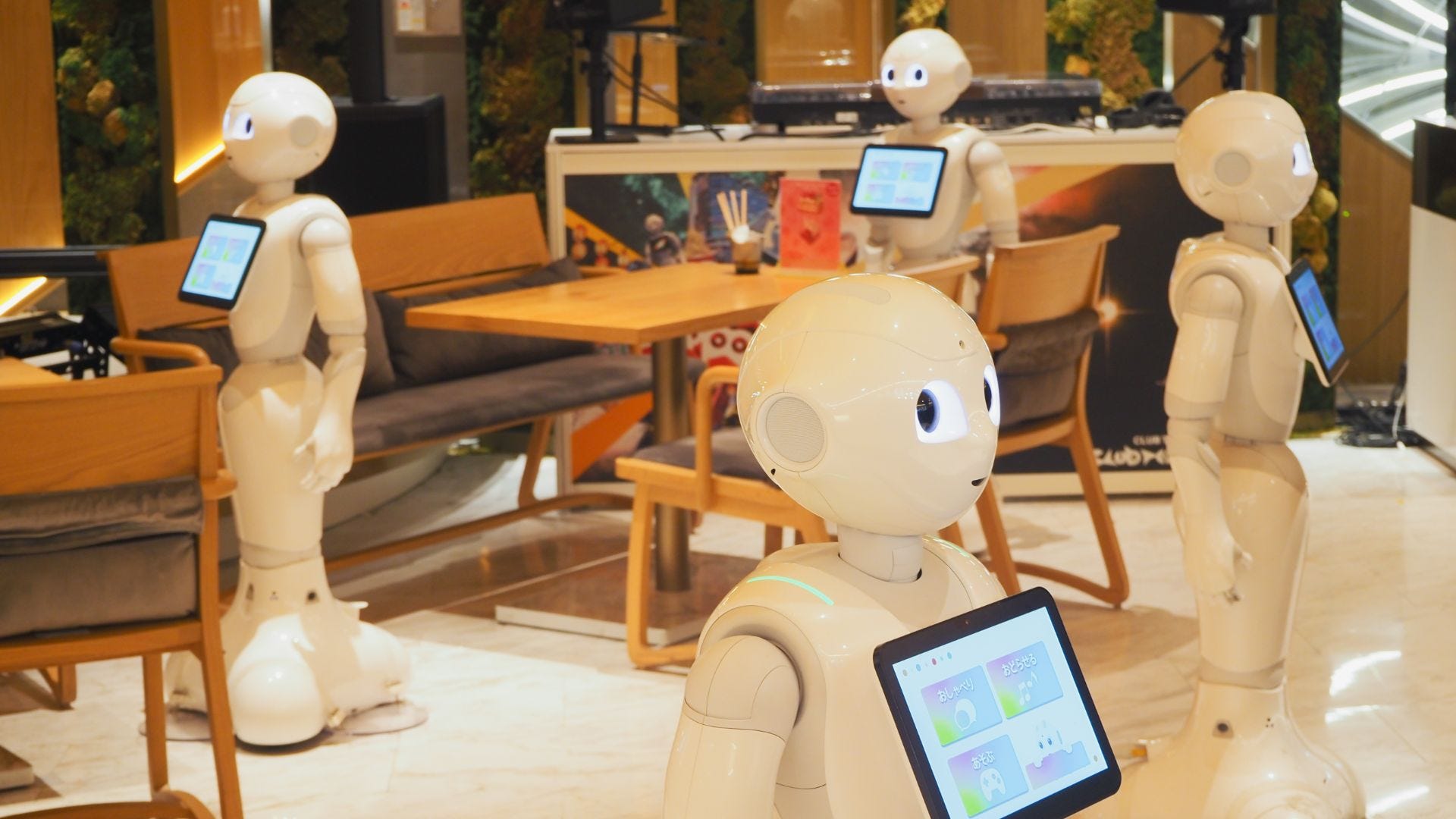
If, like me, you’re tempted to value efficiency above all else, you may find yourself grumbling under your breath while waiting in the driveway for a child to get out the door, or in a checkout line for a slow customer to get their items bagged, “Gosh…why do these people keep holding me up?” If the friction of other people is liable to hold us up in the sense of slowing us down, we should not forget that it is also what holds us up in the sense of keeping us from falling on our faces.
Rousseau solemnly intoned, “Man is born free, but is everywhere in chains,” unleashing the powerful myth that echoes today through the strains of Aladdin and Mulan. But this is ridiculous: man is born everywhere into the hands and arms of those who would care for him. Rousseau balked at the ugly spectacle of such dependence, leaving his own five children to an orphanage so he could be free to write and think unencumbered. But thoughts unencumbered by the messiness of relationships have a way of floating free from reality.
From a scientific standpoint, few things are as remarkable about human beings as just how unfree we are when we are born, how radically helpless. Despite having an unusually long gestation period for our body size, we emerge into the world exceptionally underbaked. Few of us alive today have grown up on a farm, so we could perhaps be forgiven for failing to realize how pathetic humans are in this regard; when horses give birth, their foals, all ribs and spindly legs, are usually walking on their own strength in an hour—it takes us around 10,000. By the time you were learning how to climb up on a kitchen stool to raid the cookie jar, that young foal might have been old enough to win the Kentucky Derby. For the first few years of our lives, we rely on our mothers and fathers to feed us, wash us, clothe us, carry us, and wipe the snotty noses that we seem blissfully unaware of.
Nor does this dependence end there. As we grow into adolescence and even adulthood, most of us remain physically incapable of providing for more than a handful of our own needs. Mankind’s “propensity to truck, barter, and exchange,” which Adam Smith identified as one of the more salient features of our race, is a product of this profound dependence on one another; even the so-called “self-made man” is the daily beneficiary of a thousand and one gifts that he would have little or no idea how to provide for himself.
So it is for our material needs, but even more for our psychical and spiritual needs. We depend upon the love, attention, praise, and concern of others if we are not to wither on the vine; we want others to rejoice with us when we rejoice, and mourn with us when we mourn. Even the most introverted and emotionally self-reliant among us will find his spirit starving without a small circle of friends with whom to share his joys and bear his sorrows. While Mulan may give voice to our conviction that nothing is more real and authentic than “what she thinks” and “how she feels,” nothing more autonomous and unconditioned, more purely and truly hers than “who she is inside,” great philosophers and modern psychologists alike have known better. In reality, our emotional life is the product of the web of relations within which we find ourselves; so dependent are we on others that our very thoughts and emotions are most often borrowed from them, as Smith argues in his masterpiece, The Theory of Moral Sentiments.
* * *
Our rebellion against dependence today is in part the product of a toxic ideology but also, as we have seen, of the temptations of technology. Without technology, Mulan’s comforting myth would shatter on the first contact with reality; unable to scale the pole and retrieve the arrow, she would be outed as an impostor. Today, however, as Leah Sargeant writes in her Dignity of Dependence, we have turned our technologies upon the female body in order to subdue it to the demands of a male world, offering women escape from hormones, menstruation, pregnancy, and weakness—and above all from dependence. Although Sargeant is particularly interested in the plight of womanhood today, her argument tells more broadly against our technological war on dependence. Indeed, while our culture’s concern for the disabled is laudable, it is striking that we think that they are best served by, well, making sure that they never have to be served. We have disinvested in the social technologies and institutions for caring for the disabled, and instead invested in machines and gadgets that will enable them to simulate independence. I say “simulate,” of course, because the man who depends on a machine to help him stand is every bit as dependent as the man who depends upon a caregiving wife; the illusion of independence may tickle our pride, but we will pay a high price for it in the end.
We like to call our technologies “labor-saving devices” but this is a euphemism—they are people-saving devices, shortcuts to getting what we want without the bother of other people. This is hardly a new phenomenon; it is in some measure simply what technology is, for better or worse. John Steinbeck’s The Grapes of Wrath describes the traumatic appearance of the first tractor in an Alabama farming community:
“And at last the owner men came to the point. The tenant system won’t work any more. One man on a tractor can take the place of twelve or fourteen families. Pay him a wage and take all the crop. We have to do it….The tenant men looked up alarmed. But what’ll happen to us? How’ll we eat? You’ll have to get off the land. The plows’ll go through the dooryard.”
Indeed, the slow death of the family in the modern world can be told as a technological tragedy in three acts. First, the arrival of tractors and other farm technologies rendered most children—the cheapest and most reliable farm hands—redundant. As economist Catherine Pakaluk describes it, children lost much of their economic value around the same time as horses, and for much the same reason, even if they retained more sentimental value. Second, the arrival of household appliances half a century later rendered housewives redundant; no longer did their work contribute meaningfully to the essential life of the household, and they understandably began to demand the freedom to enter the workforce and leave their stifling marriages; divorce rates rose precipitously in the decades following the advent of the washing machine. If, however, couples no longer felt the need to have children or stay married, they still felt the need to have sex; few biological urges are so basic, or, we might have thought, so inextinguishable. But the rise of the smartphone, the ultimate people-saving device, has finally broken this last primal bond. As recent research from both the Financial Times and the Ethics and Public Policy Center suggests, the smartphone is the likeliest culprit for plunging rates of sex, marriage, and childbearing observed worldwide over the past decade and a half.
Of course, the smartphone, and the infinite stream of pornography it offers, does not merely substitute for sex; it can substitute for nearly any and every form of genuine human interaction. Today, with a few swipes or taps, I can have a warm dinner, a stack of books, and a new smartphone charger delivered to my doorstep without having to see or speak to another human being. I can receive the thoughts of millions of human beings, and share my own thoughts with millions, without ever speaking to one. The thin gruel of such digitized “speech,” we have discovered, is no substitute for the rich feast of personal encounter. A century ago, the telephone replaced bodily presence, rich with sound, sight, smell, and touch, with voice alone, easier to tune out, half-listening while you fold the laundry. The advent of texting took our social distancing to another level, as we elected to communicate with one another through mere symbolic representations of our thoughts, rather than through direct vocal encounter. In her classic Alone Together, Sherry Turkle describes at length how texting quickly became the norm for young people because of the independence and autonomy it offered. One could try to have one’s cake and eat it too, snacking on the benefits of relationship while keeping free from the entangling bonds of conversation.
To be sure, as higher-speed connections made video-calling increasingly feasible, we regained the opportunity for richer personal encounter even at a distance, but as the “Zoom fatigue” of the pandemic taught us, it was still a pale shadow of embodied encounter. Which of us does not find ourselves constantly prone to multi-task while on a video-call, tempted to give others the smallest fraction of genuine attention that we can get away with? But are we any better now when we are face-to-face? In reality, we tap away under the table on our phones, somehow convinced that whatever is happening elsewhere is more urgent than whoever is present here. To be present in one place is to be tied down, exposed, vulnerable, finite; much better to float free in the cloud, never quite touching down to earth.
Social media promised to connect the world in an ever-denser and broader web of relationships, but instead it has left us all “alone together,” in Sherry Turkle’s memorable phrase, connected by loose, ephemeral and transactional ties that demand neither presence, nor sacrifice, nor sustained attention. We asked for frictionless relationships, and we got them; we now find ourselves sliding along the surface of one another, chasing our FOMO to somewhere and someone more interesting, and wondering why we can’t ever seem to stick together anymore.
* * *
By now, this observation feels obvious and cliched, but we are apt to forget the progressive stages through which our use of technology has steadily dissolved the bonds that tie us to one another. In the early days of social media, users came together to share experiences, discuss news, and debate ideas. Then, in the early 2010s, I first encountered LMGTFY, “Let Me Google That for You.” This clever little web app allowed a user to create a URL that loaded an animation of someone condescendingly typing a query into Google for you—the idea being that you should’ve just done so yourself. The webpage’s tagline is “For all those people that find it more convenient to bother you with their question than to google it for themselves.” It’s hard to think of a tagline that better expresses the anti-humanism of Silicon Valley, according to which any mark of dependence on another human being is incredibly uncool. According to this new ethos, although we still came together on the internet to speak to one another, we no longer expected to learn from one another—any information that we could conceivably need was there to be found on the internet, so why bother asking another person for it?
Of course, even then, when you Googled a fact or idea, you would still often end up at an article with a byline; in other words, you found yourself in the presence of thoughts and ideas communicated by some other human being, even if you would never meet them or know them. You were, in short, still dependent upon the authority of authorship. Today, at last, this final thread of human dependence has been severed by the advent of AI. By summarizing thousands of texts in seconds, AI disburdens me from the trouble of reading any particular person’s thoughts, and thus the humility and gratitude of acknowledging my dependence on their insights.
What we gain in efficiency we pay back with interest later. It turns out that even the trivialities of small talk, our seemingly-pointless exchanges of information about the weather, or an upcoming sports game, often provide the first little hooks on which the threads of deeper relationships are later woven. Today we have little occasion to ask one another for directions, or weather forecasts, or restaurant recommendations; we just whip out our phones. I still remember the days, not long since, when evenings with extended family could be sustained by lively arguments over which films a given actor or actress had appeared in; today, however, someone will end the debate fifteen seconds in by asking ChatGPT, and soon everyone will be privately scrolling again, alone together.
* * *
This loss of informational dependence does its deepest damage to childhood. Once they get past nursing and diapers, children’s dependence on their parents is intellectual above all: “what’s this? what’s that?” they repeat with irrepressible curiosity, jabbing their stubby fingers in the direction of every new sight or sound. They ask their parents to name the world for them, so that they might learn to repeat these names with familiarity and indeed love, a gift received from the lips of the parents who love them. As they grow older, their questions make up in difficulty anything they lose in frequency. “What does ‘sex’ mean?” “Why do all my friends hate me?” “Should I marry my boyfriend?” In a healthy family, the parents are the first people to whom a confused daughter is likely to pose these questions—or used to be.
In the name of giving their children independence (and of giving themselves more leisure), parents give the three-year-old the iPad to teach him his shapes and colors, the nine-year-old the Chromebook to teach him geography and the meaning of “sex,” and the thirteen-year-old an AI-enabled smartphone so that she can carry a personal friend and therapist around in her pocket. And then we wonder why today’s youth feel like they are floating through life without anchors, meaning, or purpose, why so many of them are asking the AI at last, “how do I kill myself?”
The greatest irony of all this is, of course, that no one has escaped dependence in this scenario. The farmers in Grapes of Wrath were slaves to the banks who lent them the money for the tractors, and we are today the willing slaves of a handful of tech platforms of unprecedented size and power, turning to the same three or four companies to order our groceries, answer our questions, solve our problems, and simulate companionship for us on demand. All these companies ask in return is our bodies, our souls, and our worship. C.S. Lewis’s warning from The Abolition of Man cannot be repeated often enough: “What we call man’s power over nature is actually some men’s power over other men using nature as its instrument.”
* * *
It is important, however, for us to be honest with ourselves about this situation. Too many books have been written with Big Tech as the villain, and we—the users, the addicts—as the passive victims. There is plenty to say about the economics of exploitation which this industry practices, and the political abdication that has made it possible. But however unfree this market, it is really and truly a market, which means that there are millions, or rather billions, of buyers on the other side of the trade. They—we—are buying autonomy, independence, anonymity. For while we may complain about our lack of “data privacy” online, in fact most of us are perfectly happy to click “Accept All Cookies.” For while we surf the internet, most of us already enjoy a greater privacy—at least from the neighbors and authorities that most concern us—than any previous generation could imagine. Even though our every thought and movement has been opened up to the comprehensive surveillance of Big Data’s panopticon, it seems a small price to pay for anonymity. We have traded, in other words, what felt like the repressive oversight of close-knit communities—family, church, and school—for the much more distant and non-judgmental oversight of Meta, Google, and OpenAI. If we can escape being manipulated by our parents, pastors, and spouses, we reason, we are more than willing to let ourselves be manipulated by targeted advertisers, feed aggregators, and omniscient AIs.
At the opening of C.S. Lewis’s The Great Divorce, the protagonist finds himself at a bus stop trying to escape a vast, ever-sprawling suburb whose denizens are constantly trying to move further away from one another so as to avoid the trouble of human interaction. The issue, a fellow passenger explains, isn’t “that people are quarrelsome—that’s only human nature and was always the same even on earth. The trouble is they have no Needs. You get everything you want (not very good quality, of course) by just imagining it. That’s why it never costs any trouble to move to another street or build another house.” We are not very far off from such a world today, and if our utopian overlords have their way, AI will soon usher us into to the abundance of such a post-scarcity economy, a Paradise without the bother of other people.
Only in The Great Divorce, this city went by another name.
The above essay is an excerpt from a draft-in-progress of chapter 6 of my forthcoming book Left to Our Own Devices: Reclaiming Human Agency in the Age of the Machine (working title).
Incredible post. We rarely get such detailed thinking lately and its great evidence of Lewis'(and the Inklings, really) rich intellectual traditions that yet save s.
Great article; you are an excellent writer, but what the heck is FOMO? (“chasing our FOMO to somewhere and someone more interesting”…)? And no, I’m not going to google it 🤣