
The First Amendment as Suicide Pact
Originalism: meet conservative tech policy

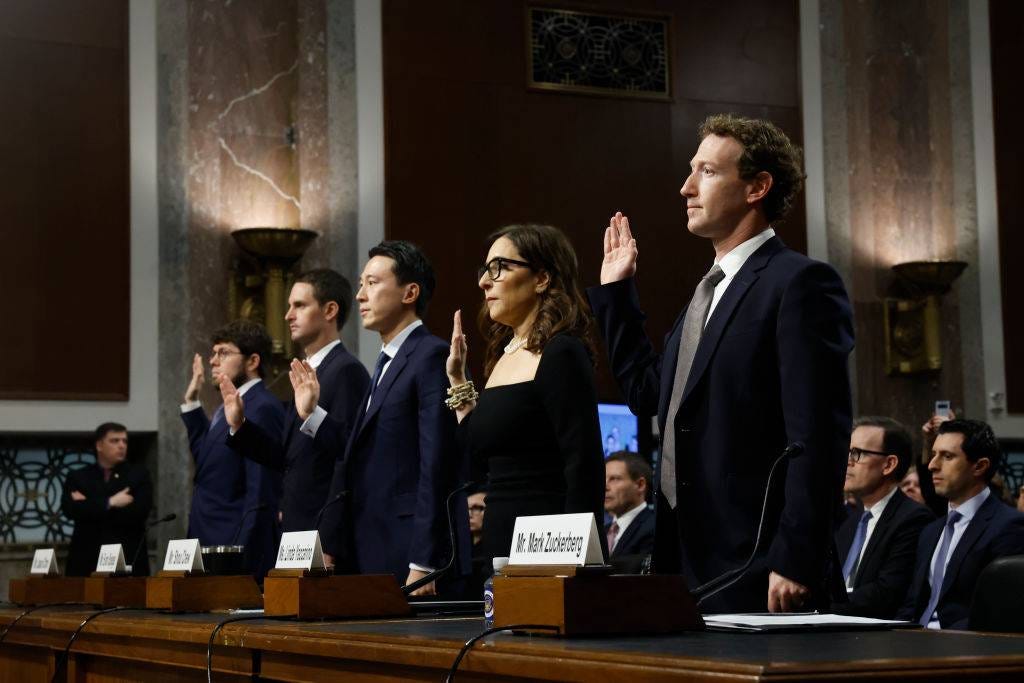
When exactly was it when conservatives embraced Silicon Valley transhumanist Elon Musk as one of their own? Was it when he began sounding the alarm about China and calling for a muscular US foreign policy? Hardly; Musk has always craved access to the Chinese market. Was it when he began lamenting the decline of American communities and folkways? Or championing a renewal of the country’s moral fiber and the importance of the traditional family? Pardon me while I snort on my Dr. Pepper.
No, it was when he took control of Twitter in 2022, and proclaimed himself the great global champion of free speech. This past week, Musk made it clear what he meant by “free speech,” trolling and mocking critics of Grok’s “bikini mode,” as reports spread of the chatbot’s willingness to generate deepfake pornography, including child sexual abuse material, on demand. Of course, Musk’s understanding of the First Amendment has never been remotely conservative—but he is hardly alone in this. For a couple generations now, both Right and Left have conspired to strip First Amendment law of almost any meaningful guardrails or historical context, much to the delight of the exploding tech industry. While conservatives lambasted the tech companies for their “censorship” in 2020 and 2021, their lawyers were quietly invoking the First Amendment at every turn, demanding unlimited protection for addictive and exploitative algorithms. Most recently, this trend has taken a truly surreal turn, when Google’s lawyers invoked the free speech rights of CharacterAI’s chatbot to try and escape liability for its seduction and suicide encouragement of 14-year-old Sewell Setzer.
Thankfully, the Florida district judge was unimpressed with this argument, and earlier this week, Google’s lawyers announced that they were settling with the plaintiffs. But don’t expect the debate about “First Amendment rights for AI” to go away. Even if courts decide that the bots themselves don’t have rights, they may well treat their algorithmic outputs as the protected speech of the AI companies, based on the trend of recent precedents. Meanwhile, the First Amendment continues to be freely wielded as a defense for the most brutal forms of hardcore pornography, for the virtual prostitution of OnlyFans and similar platforms, and for the sale of videos depicting animal torture.
How on earth did we get to this point? Surely conservatives have spoken up on the grounds of “originalism”—the principle at the heart of the conservative legal revolution over the last generation? After all, none of these contemporary applications could, by any stretch of the imagination, be attributed to the original drafters of the Bill of Rights. Unfortunately, conservatives have been mostly AWOL during this grotesque inflation of “free speech” rights, or have even actively connived in it—finding it a useful shortcut to defend the conscience rights of social conservatives in cases like 303 Creative v. Elenis. In reality, originalism has been selectively applied, and thus far, it has been convenient for most interested parties to leave the “free speech” clause untouched by any historical scruples.
The results have been disastrous, and are likely to grow ever more so in an increasingly informationalized economy. Consider: If algorithms are treated as forms of protected speech, and we live in a world where everything from your refrigerator to your car is run on algorithms, what does that mean for consumer protection? It may seem absurd to imagine a world in which Tesla’s lawyers reject autonomous-car regulation on the grounds that it is restraining the “speech” of their algorithms, and yet this is but a logical extension of defenses that TikTok and Meta have already successfully mounted. In the memorable words of Justice Robert Jackson, “if the Court does not temper its doctrinaire logic with a little practical wisdom, it will convert the constitutional Bill of Rights into a suicide pact.”
It is to offer such a bracing dose of practical wisdom that my friend John Ehrett and I published “The Post-human First Amendment” this week in National Affairs (though my own role was more one of co-brainstormer than co-author; the magnificent constitutional arguments are all John’s).
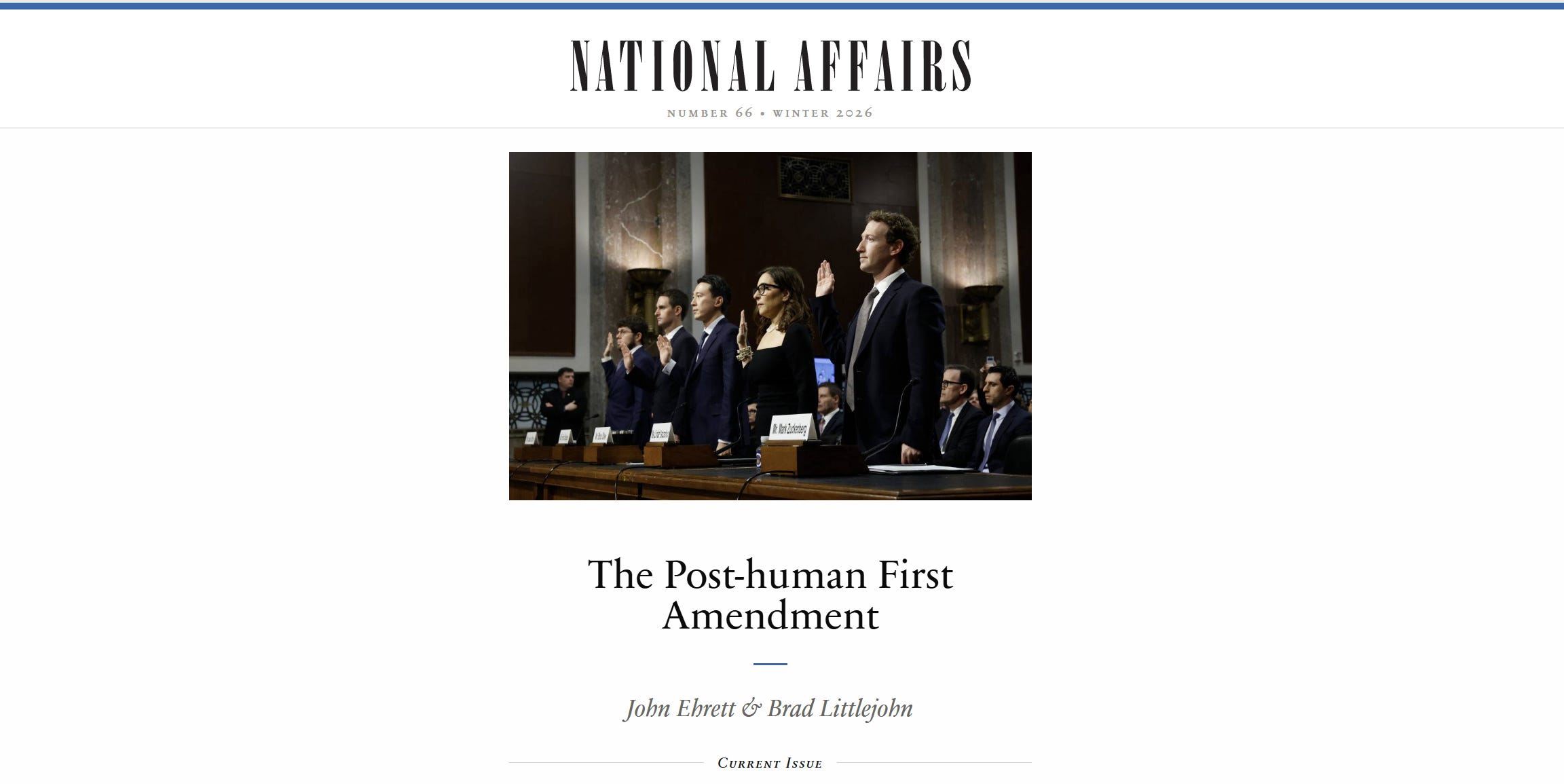
In it, we argue that there have been three great transformations in free speech doctrine over the past 75 years that have fundamentally eroded the Founders’ intentions and the legal traditions that once made America great.
First, rights like the First Amendment used to be understood as natural rights, which is to say, grounded in natural law—in the metaphysical and moral realities of personhood. John writes:
Rights were irreducibly bound up with the concrete character of the rights holder. A human being has the right to free speech because, by nature, he has the power to speak freely — not because the government has decided, through its constitution, that it will not punish speech in general. As Erika Kirk recently put it with bracing clarity at her husband’s memorial service: “The First Amendment of our Constitution is the most human amendment. We are naturally talking beings, naturally believing beings. And the First Amendment protects our right to do both.”
When this understanding was lost, “free speech” rights became free-floating, able to be attached to any entity capable of generating a simulacrum of speech—like a chatbot.
Second, we used to understand the common-sense distinction between “speech” and “conduct.” Indeed, this is an absolute bedrock of our legal tradition, without which the First Amendment would make utter nonsense of our institutions. Thankfully, the distinction remains in theory, but it has been deeply eroded in practice by the courts’ willingness to treat “expressive conduct” as a form of “speech.” Again, from our essay:
“All possible conduct cannot count as “expressive,” else there would be little room for law at all. So, in an attempt to cabin the potentially infinite creep of this logic, in 1974 the Court laid down some markers for what could count as First Amendment-protected expressive content: whether there was “[a]n intent to convey a particularized message,” and whether “in the surrounding circumstances the likelihood was great that the message would be understood by those who viewed it.”
If the goal was to articulate a limiting principle, this test was not particularly successful. Since 1971, caselaw reflects an ever-broadening definition of what conduct counts as “expressive.” The Court even concluded in 2000 that nude dancing counted as “expressive conduct that is entitled to some quantum of protection under the First Amendment,” with the grudging proviso that such behavior “falls only within the outer ambit of the First Amendment’s protection.” It is virtually impossible to envision the founders reaching such a conclusion or following such logic. And yet what was the “outer ambit” has gone mainstream with the advent of OnlyFans, a platform for virtual prostitution that now boasts more than 4 million “content creators” worldwide, a large share of them American women.
Third, until the later 20th century, American courts did not extend First Amendment protections to “commercial speech” such as advertising. The grounds, again, were once common-sense: the purpose of the First Amendment was to protect citizens’ right to engage in rational deliberation, not companies’ right to make money. Not that companies don’t have a right to make money in American law—they clearly do—but that doesn’t mean that anything they might say in pursuit of profit is entitled to constitutional immunity. This shift, at least, did not go unremarked or uncontested. As John writes:
In 1980, future chief justice William Rehnquist complained that “the Court unlocked a Pandora’s Box when it ‘elevated’ commercial speech to the level of traditional political speech by according it First Amendment protection.” Justice Stephen Breyer echoed the metaphor three decades later, warning of “a Pandora’s Box of First Amendment challenges to many ordinary regulatory practices that may only incidentally affect a commercial message. At worst, [this] reawakens [the] pre-New Deal threat of substituting judicial for democratic decisionmaking where ordinary economic regulation is at issue.” For Breyer, just as for Rehnquist, the elected representatives of the American people should be able to pass laws to hold business corporations accountable. Radically expanding the scope of free-speech law would make that far harder.
But these cautions have gone largely unheeded, as commercial speech protections have steadily expanded.
In short, we have turned the First Amendment from the protection of the natural right of human beings to rationally pursue truth and debate the good to a protection of any and all forms of “information” or “expression” by any party, however cynical or degraded.
We sum up:
These three revolutions did not occur in isolation. And today, their effects converge. More and more entities believe they are owed free-speech protections, irrespective of whether any human speakers are involved. More and more kinds of non-speech behavior can be framed as "free speech" — thereby making it far harder for the government to impose liability when circumstances would otherwise demand it. And more and more categories of communicative material, whether or not there's any real "expression" involved, enjoy First Amendment protections.
...
In the end, how effectively can the common good be pursued under these conditions? When everything becomes a “First Amendment issue,” governance as such becomes effectively impossible. Must every government action that implicates “speech” (or algorithms) clear a nearly insurmountable constitutional bar?
To make such an argument is to insist that the Constitution — specifically, its free-speech guarantee — become a mechanism for destroying America’s “constitution,” or the legal and social and cultural fabric of the nation itself.
In the final section of the essay, we sketch a path back to sanity, drawing upon some encouraging trends in recent jurisprudence and tech litigation, and calling on judges to change the course of two generations of bad precedent before our society becomes wholly ungovernable.
I encourage you to take time to read and share the entire essay.
This historiography was very helpful.
I had never thought much about the now rather obvious distinction between speech and expression. And the scope creep of what is counted as expression. In a world where every human act expresses one’s sacred inner self, free expression leads only to anarchy.
Great stuff. Thanks Brad.